What does the forecast show?
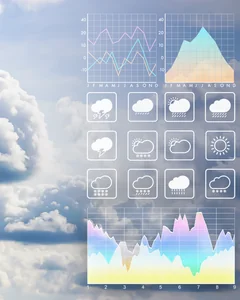
DIGERATI forecasts solar irradiance, the amount of solar energy reaching the surface. Rather than showing only one predicted value, DIGERATI also shows the uncertainty around the forecast. The median forecast (P50) represents the expected value, while the range between P5 and P95 shows the 90% prediction interval.
Choose how far you want to explore

Explore the public forecast
See DIGERATI in action using our public forecast. No registration is needed.
- Standard forecasts for available locations and datasets
- Immediate access and use.
- Helps teams understand and visualize solar uncertainty
- Ideal for assessing the value of the approach

Evaluate DIGERATI for your locations
Want to see how DIGERATI could work in context closer to your own?
Get free access to two months and test forecasts up to 10 locations relevant to your network, portfolio, or market activities.
Benefits of personalized demo access:
- Test forecasts for locations relevant to your operations.
- Explore and compare forecasts across up to 10 sites.
- Evaluate DIGERATI over a two-month period.
- Identify which data could support a future customized deployment.
- Share the evaluation with colleagues and gather feedback.

Go beyond forecasting
Put solar forecasts to work in your operations.
CSEM can work with you to adapt DIGERATI's predictive capabilities to your market activities, data, and operational processes.
CSEM can help you take the next step through:
- Aggregate forecasts Combine forecasts across a portfolio or balance group to support market and energy-management decisions.
- Integrate forecasts into your processes Connect forecasting outputs with your existing operational tools, workflows, and decision-making processes.
- Improve forecasts with your own data Use your PV, weather, or measurement data to develop forecasts better adapted to your application.
 Forecasts for short-term energy decisions
 Up to 24 hours ahead with 15-minute forecasts
 Solar irradiance or PV power
 Quantified uncertainty
 Local data integration